Loading...
← All work
Case study · PlantsightConcept
An asset register you can trust, built from photos you already take.
Computer vision finds nameplates, valves and safety tags in site photos. A language model turns the raw text into clean records and flags what is missing or out of date.
- Sector
- Energy & Industrial Inspection
- Our role
- Computer vision, OCR pipeline, LLM structuring, rules engine
- Capabilities
- AI & agents · Automation
- Status
- Concept build
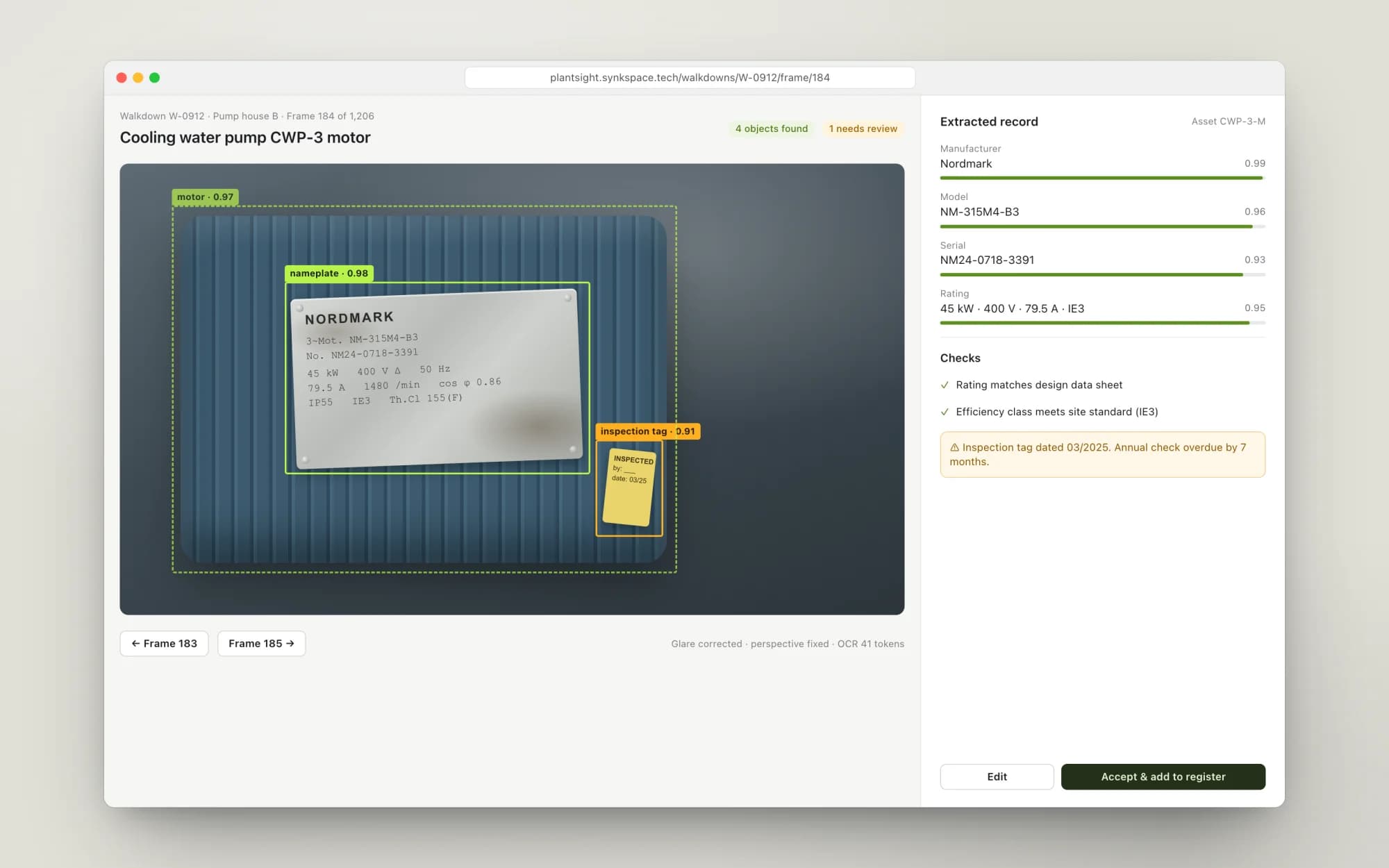
Concept build: an architecture we design and deploy for clients. Screens and data are illustrative.
The challenge
Most plants do not know exactly what they own.
Most plants do not know exactly what they own. Registers are years old, nameplates are scratched, and a walkdown produces thousands of photos nobody has time to read. Plantsight turns the photos into a register that can be checked and trusted.
What made it hard
- 01
Stale ground truth
Asset registers are years out of date, and a manual walkdown takes weeks nobody has.
- 02
Adversarial images
Nameplates are scratched, angled and glared, across thousands of photos per walkdown.
- 03
Explainable compliance
A flag has to be traceable to a rule an auditor can read, not to a model’s opinion.
The approach
Vision finds, language interprets, deterministic rules decide.
A YOLO detector localises assets in each frame. Crops are pre-processed for glare and perspective before OCR. An LLM maps noisy text to a typed Pydantic schema with a per-field confidence score, and a deterministic rules engine checks each asset against its standard. Only low-confidence reads are routed to a human.
System map
- AI step
- Person in the loop
- Service or store
How it works
- 01
Capture
Photos from phones, helmet cameras or drones arrive tagged with area and time.
- 02
Detect
A detector finds nameplates, gauges, valve handles, panels and inspection tags in each frame.
- 03
Read
Each crop is cleaned for glare and angle, then read by OCR.
- 04
Understand
A language model turns messy text into manufacturer, model, rating and serial, and says how sure it is.
- 05
Check
Rules compare each asset with the expected standard: missing lock-out tag, expired inspection, mismatched rating.
- 06
Review and export
Low-confidence reads go to a person. The rest export to a register, a punch list or the maintenance system.
Key decisions
Why its answers can be trusted.
Decision 01
Confidence travels with the data
Every field carries a score, so reviewers spend their time only where the system is unsure.
Decision 02
Vision finds, language interprets
Each model does the job it is good at, and the boundary between them is a typed schema.
Decision 03
Rules stay deterministic
Compliance checks are plain code against a standard, so an auditor can read exactly why something was flagged.
What shipped
From walkdown photos to a checked register.
Photo ingestion
Phones, helmet cameras or drones, tagged with area and timestamp.
Object detection
Nameplates, gauges, valves, panels and inspection tags localised per frame.
OCR pre-processing
Glare and perspective correction before text recognition.
Schema-bound extraction
Manufacturer, model, rating and serial, each with a confidence score.
Rules engine
Missing lock-out tags, expired inspections and rating mismatches flagged.
Review queue and export
Below-threshold reads go to a reviewer; the rest export to a register or CMMS.
Architecture
A cross-section of the system.
Every layer, from what people touch down to where it runs, and the one job each layer does.
L1Output
Excel / PDF export
Registers, punch lists and maintenance-system exports.
L2Rules
Deterministic checks
Plain-code compliance checks an auditor can read line by line.
L3Intelligence
YOLO+OCR+LLM
Detection, text recognition and schema-bound interpretation with confidence.
L4Services
Python+FastAPI+Pydantic
Typed pipeline API with validation at every stage boundary.
Our scope
Computer vision/OCR pipeline/LLM integration/Compliance rules engine/Reporting
Where it is now
A reference architecture for industrial inspection.
Plantsight is a concept build: the pipeline we design and deploy for energy and industrial clients. Screens and data are illustrative. Confidence scoring and deterministic checks are what make it trustworthy on a real site.
Something like this in mind?
Tell us the problem. We will tell you honestly if we are the right team to solve it.