Loading...
← All work
Case study · ForgelineConcept
A coordinated response for every breakdown on the factory floor.
Voice and SMS agents take breakdown calls from the floor, read the asset history, line up the technician and the parts, and stop at a human wherever safety is involved.
- Sector
- Manufacturing & Heavy Industry
- Our role
- Multi-agent architecture, voice and SMS AI, safety-gate design
- Capabilities
- AI & agents · Automation
- Status
- Concept build
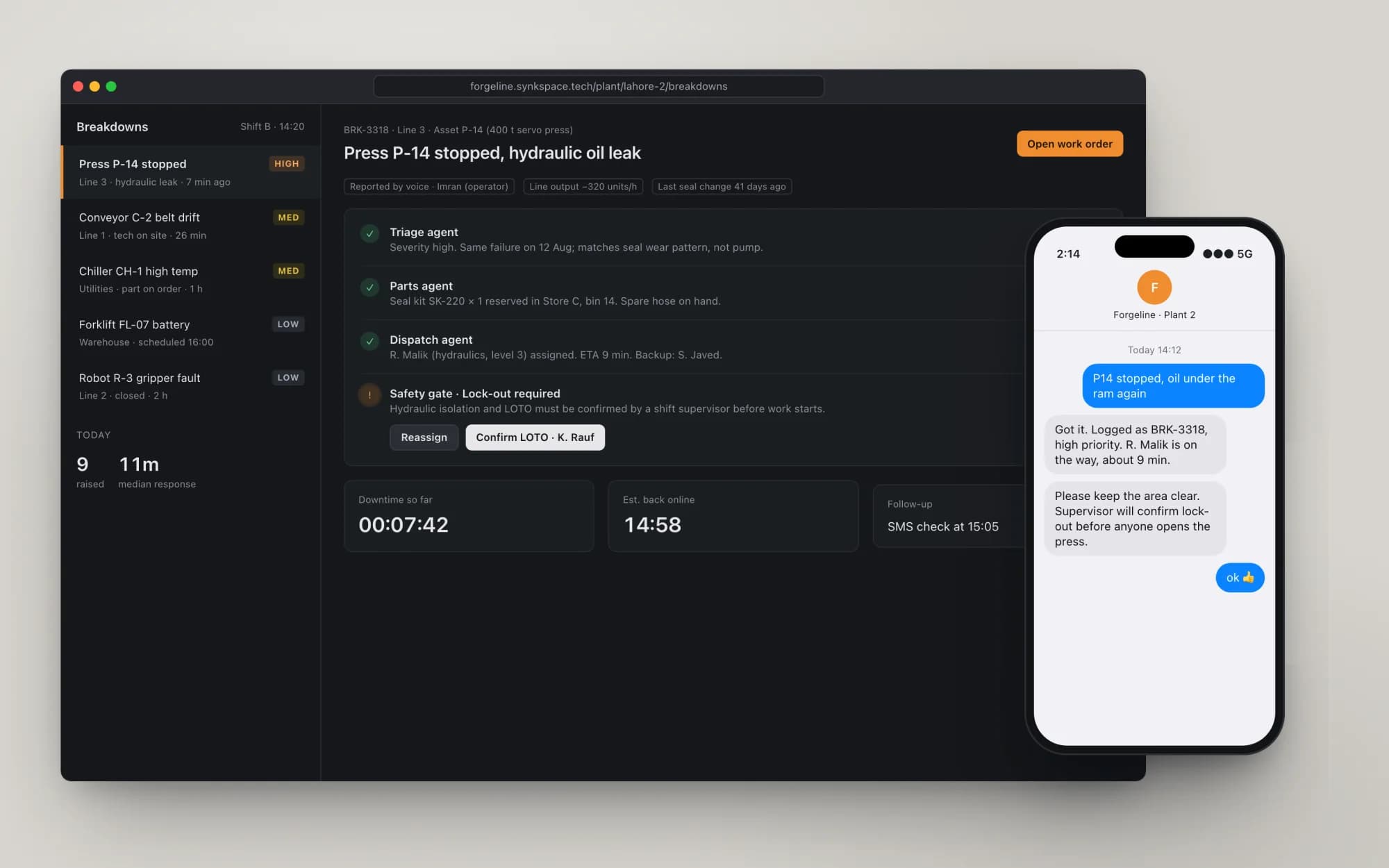
Concept build: an architecture we design and deploy for clients. Screens and data are illustrative.
The challenge
When the line stops, the first ten minutes decide the shift.
When a press or conveyor stops, the first ten minutes decide the shift. The call goes to whoever picks up, the history lives in three systems, and the right part is in the wrong store. Forgeline treats every breakdown as a coordination problem and hands each piece to a specialist agent.
What made it hard
- 01
Fragmented context
Asset history, technician skills and spare-parts inventory live in three disconnected systems.
- 02
Unstructured intake
Breakdowns arrive as voice calls and texts from the floor, with no ticket, no asset ID and no priority.
- 03
Non-negotiable safety
Lock-out, hot work and confined-space jobs need a named human approval that no automation may bypass.
The approach
Specialist agents on a durable job queue, with safety enforced in code.
Each breakdown becomes a job. A triage agent scores severity against asset history and the production schedule, then dispatch and parts agents run in parallel on a durable queue, so a dropped call or a restart never loses work. Safety-critical steps are a hard gate in the workflow, not an instruction in a prompt.
System map
- AI step
- Person in the loop
- Service or store
How it works
- 01
Hear it
A call or text from the floor is transcribed and tied to an asset, a line and a shift.
- 02
Triage it
A triage agent scores severity against the asset’s history and the production schedule.
- 03
Line it up
Dispatch and parts agents work in parallel: nearest qualified technician, and the part, in stock or on order.
- 04
Gate it
Anything touching lock-out, hot work or confined space is held for a named supervisor. Agents cannot skip this step.
- 05
Close it
A work order is written to the maintenance system, and a follow-up agent chases anything unconfirmed.
Key decisions
Where the architecture earns its trust.
Decision 01
Safety is a gate, not a prompt
The human checkpoint is enforced in code. No instruction to an agent can route around it.
Decision 02
One model entry point
Every model call goes through a single module, so swapping providers or adding audit logging is a one-file change.
Decision 03
Queues over chains
Agents communicate through durable jobs, so a dropped call or a restart never loses a breakdown.
What shipped
A breakdown response fleet.
Voice and SMS intake
Calls and texts transcribed and resolved to an asset, a line and a shift.
Triage agent
Severity scoring against asset history and the live production schedule.
Parallel dispatch
Technician matching and parts sourcing run concurrently as separate jobs.
Human-in-the-loop gate
Hazardous work is held until a named supervisor confirms.
Work orders and follow-up
Written to the maintenance system, with an agent chasing anything unconfirmed.
Architecture
A cross-section of the system.
Every layer, from what people touch down to where it runs, and the one job each layer does.
L1Console
Next.js
Supervisor view of live breakdowns, agent steps and pending safety gates.
L2Agents
Triage+Dispatch+Parts+Follow-up
Specialist agents, each with one job and one model entry point.
L3Orchestration
Job queue+Node+TypeScript
Durable, retryable jobs instead of fragile agent chains.
L4Channels
Voice AI+SMS
Speech and text intake from the floor, and replies back to it.
L5Data
Postgres
Assets, breakdowns, jobs and the audit trail of every gate decision.
Our scope
Multi-agent architecture/Voice AI/Safety and compliance design/Workflow orchestration/Operations console
Where it is now
A reference architecture, ready for a real plant.
Forgeline is a concept build: the architecture we design and deploy for manufacturing clients. Screens and data are illustrative. The agent topology, the durable queue and the safety gates are what we bring to a real line.
Something like this in mind?
Tell us the problem. We will tell you honestly if we are the right team to solve it.